


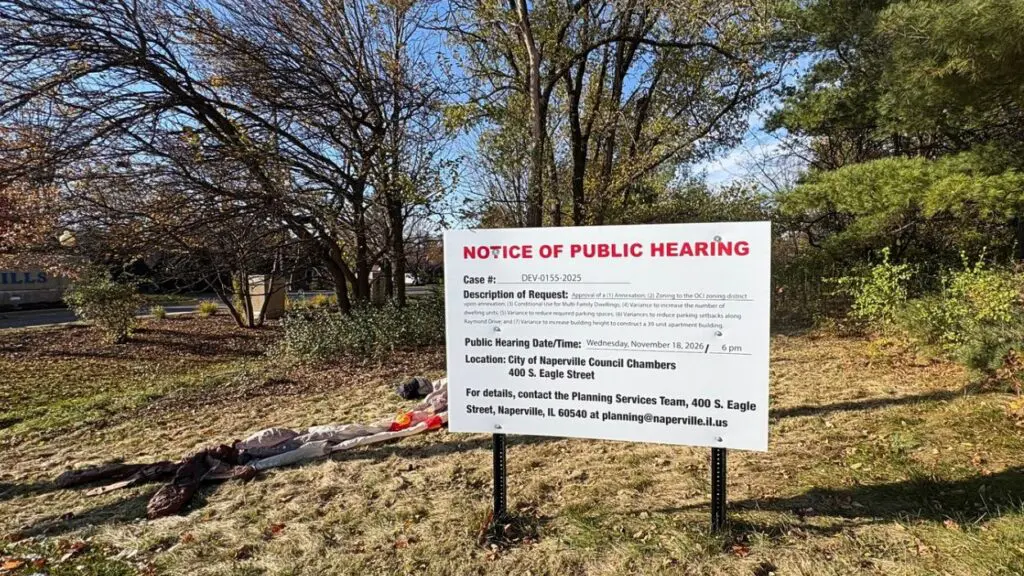
A proposed 39-unit multi-family residential development just outside Naperville’s municipal limits in unincorporated DuPage County received an unfavorable vote recently from a city panel.
Petitioner McDowell Grove Place LLC submitted plans to the city for the apartment development, named McDowell Grove Place, on a 1.28-acre parcel at the northwest corner of Raymond Drive and Crystal Avenue. The property has a current address of 5S022 Raymond Drive.
The Naperville Planning and Zoning Commission combed through the proposal at a meeting Wednesday, Nov. 18. None of the eight commissioners in attendance provided a favorable recommendation to the city council.
Workforce housing part of the development proposal
Jimmy Calvo with the Naperville-based law firm of Calvo Law Offices served as the project spokesperson at the recent meeting. He outlined a proposal that included six studio units, 30 one-bedroom units, and three two-bedroom units.
The proposal entails a 4-story development, with a total gross footprint of 52,692 square feet.
“The vision behind this building is workforce housing,” Calvo said. “We feel like this is a perfect location for the workforce housing that the city needs.”
The property’s location, in close proximity to downtown Naperville and the I-88 and Route 59 corridors, makes it an ideal candidate for workforce housing, Calvo said in his pitch to the commissioners.
McDowell Grove Place LLC is seeking eight entitlements from the city for the project, including a nearly double number of units allowable under city code. Based on the square footage, the code allows 21 units in the office, commercial and institutional zoning that is sought for the property.
“Thirty-nine units on this lot will not alter the essential character of this neighborhood,” Calvo said.
The proposal also includes what has been described as an “attainable housing” component, with fixed pricing that would be afforded to income-qualified households. Calvo said the proposal includes accommodations for four of the 39 units in the attainable housing category.
“The restriction would be long-term, and it would be secured by a recorded agreement with the city and run with the land, so that would include future landowners,” Calvo said. “The agreement would set who qualifies for those units, how the rent is set, how long the restrictions would last, and then how it’s maintained and enforced.”

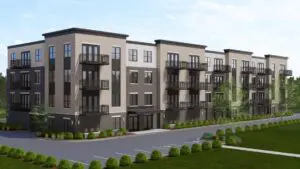
Architectural rendering of McDowell Grove Place, courtesy Torch Architecture, McDowell Grove Place LLC
Nearby Tabor Hills seniors raise concerns
Prior to the recent meeting with commissioners, representatives with the development held a neighborhood meeting to go over the project proposal. Overarching concerns at that meeting reportedly included traffic impact, security, and trespassing within the adjacent Tabor Hills Senior Living Campus development.
Commissioners received nearly two dozen written comments in opposition to the project proposal. Four Tabor Hills residents, as well as the development’s CEO, also spoke at the recent meeting during a public hearing.
Ardy Stevens expressed concerns with the impact the development could have, from a quality of life perspective.
“Many of us grew up here, raised our families here, paid our taxes to the school district,” Stevens said. “This place is where we wanted to go. Everything else for seniors is way out of our league; it’s expensive high rises. This is perfect for us.”
Nancy Leary was one of multiple Tabor Hills residents who commented on the project proposal’s density and traffic impact.
“It seems to me that if the property needs this many variances, it is probably too small or not suitable for this development,” Leary said. “We are asking for responsible planning, consideration for public safety, and respect for the established senior community that has been here nearly 30 years.”
In addition to his comments to commissioners, Anthony Harvat, CEO of Tabor Hills, sent commissioners a 4-page letter outlining the reasons for opposition.
“The addition of 39 residential units will increase traffic volumes, turning movements, and pedestrian activity in the immediate vicinity,” Harvat wrote in the letter.
He added, “We believe a comprehensive traffic impact analysis is necessary to determine whether existing roadways and access points can safely accommodate the proposed development without adversely affecting neighboring properties.”
For his part, Calvo indicated a traffic impact study was conducted that projected 17 morning trips and 21 evening trips among the residents of McDowell Grove Place, accounting or less of the 1% of traffic on Raymond Road during peak traffic hours.
“The reason the impact is so limited is that a building of this size, and this unit type, just does not generate a lot of additional traffic,” Calvo said. “It does not put a lot more cars on an arterial during the peak hours, relative to how many cars are already traveling on that arterial.”

Commissioners take issue with variance requests
While several commissioners praised the workforce housing accommodations, as well as the income-eligible attainable housing component, the entire panel said they were uncomfortable providing a favorable recommendation at this time.
Several commissioners, including Allison Longenbaugh, expressed concern with the nearly doubling of units that are allowable under city code.
“I do feel that housing is appropriate here, and even housing with some density, so it wouldn’t be out of place,” Longenbaugh said. “But that said, 39 (units) is a big increase over 21 (units). I also could not find any hardship in the response to standards or even the comments tonight. Market demand is not a hardship.”
Meghna Bansal said she sees potential in the project, but also said she could not back the plans presented.
“I understand and recognize the growing need for housing in Naperville,” she said. “However, we must be mindful for the people who already call Naperville home. Growth is important, but so is predicting the quality of life for existing residents.”
Stay in the know – sign up for our daily news update!