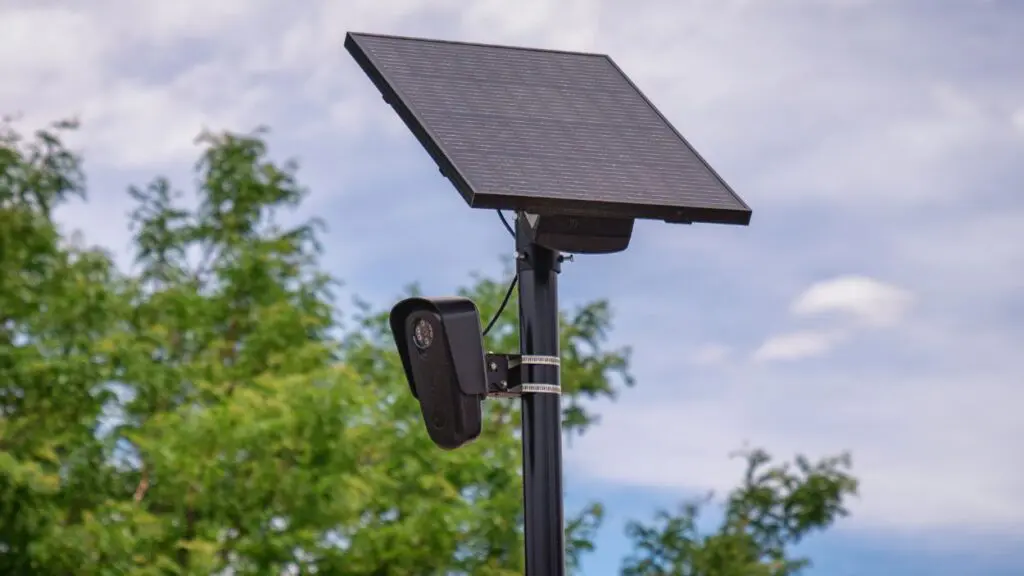
Will County has approved intergovernmental agreements that will allow several municipalities — including Naperville — to place or keep license-plate-reading cameras along county highways.
The topic drew roughly two hours of conversation during the board’s most recent meeting, in which a slim majority approved the agreements with Naperville, as well as Crete, Frankfort, Manhattan, Mokena and Wilmington.
Naperville’s pact with Will County is an extension of a previous intergovernmental agreement, which allowed license plate-reading cameras within county right-of-way beginning in late 2022. The city council approved the new deal in June, preceding the county’s vote last week.
Concerns voiced about license-plate-reading cameras
Several Will County police chiefs spoke in favor of the license plate readers — sold by a company called Flock Safety and known as Flock cameras or LPRs for short. But ten Will County residents voiced concerns about surveillance, a lack of privacy, possible data misuse and the potential for abuse.
“I think there’s a lot of people who have a lot of concerns about how this technology is being used,” Will County resident Jeffrey White said.
Naperville Police Chief Jason Arres said he understands public concerns and the level of trust placed in police as they use LPR technology.
“When law enforcement is given access like this, the public should expect safeguards,” Arres said. “LPR technology isn’t unique in that regard. Officers are entrusted every day with tremendous authority and access to sensitive information.”
‘Against our rights,’ or tool for police?
While some county board members said they support the cameras for their ability to help law enforcement, others expressed concerns similar to those from the public.
“It’s just against our rights,” said Steve Balich, a Republican county board member from Homer Glen. “Our liberties are more important than this surveillance.”
With a slim majority of 14 members approving the camera placement agreements, opinions varied. Frankie Pretzel, a Republican from New Lenox, said he ran on a platform of advancing public safety and thinks the LPRs are a must.
“I don’t understand why we’re even questioning this,” Pretzel said. “It’s a tool police are asking us to give them. I’m a hard yes on this.”
County Board member Julie Berkowicz of Naperville also said she supports continued use of the cameras. She said some subdivisions in her district have installed their own safety cameras and are seeing positive results.
“It has reduced crime, brought peace and increased public safety,” she said.
How Flock cameras work
A representative from Flock Safety also spoke during the county board’s meeting. Dan Murdock, regional sales manager for the greater Chicago area, said the first Flock cameras came into Will County in 2020, and Flock now provides cameras to police in all towns within the county except Lockport. He explained how the cameras work and what they can — and can’t — see with each shot captured.
“The camera takes a picture of the rear of the vehicle and allows law enforcement to look for vehicles based on make, color, type of vehicle and descriptive features, like roof racks or bumper stickers,” Murdock said. “What they do not do is facial recognition. Flock has made very public statements that we will never do facial recognition.”
Oversight already exists within the way police officers access the Flock camera system, Arres said. To conduct a search, an officer has to enter a case number and the type of crime or police-related activity to which the search is related.
“Those searches are all able to be audited and justified to see if the officer had a legitimate law enforcement purpose,” Arres said. “There are consequences if they didn’t — not a slap on the wrist.”
Will County drafting ordinance for oversight of LPR use
The county board’s Public Works & Transportation Committee reviewed the LPR agreements before sending them to the full board for approval. County Board member Jacqueline Traynere, a Bolingbrook Democrat, chairs the committee. She said the county plans to enact an ordinance to establish safeguards against police misuse of the photos gathered by the cameras.
Arres said he fully supports accountability.
“The answer has never been to take those tools away because they potentially could be misused. The answer is to establish strong policies for their use and hold people accountable if they violate that policy,” Arres said. “We have accountability in place today, and we’re committed to making it better tomorrow.”
Photo: File image by Tony Webster, Wikimedia Commons / Creative Commons Attribution 2.0 Generic License
If you have a story idea, send us a tip!