
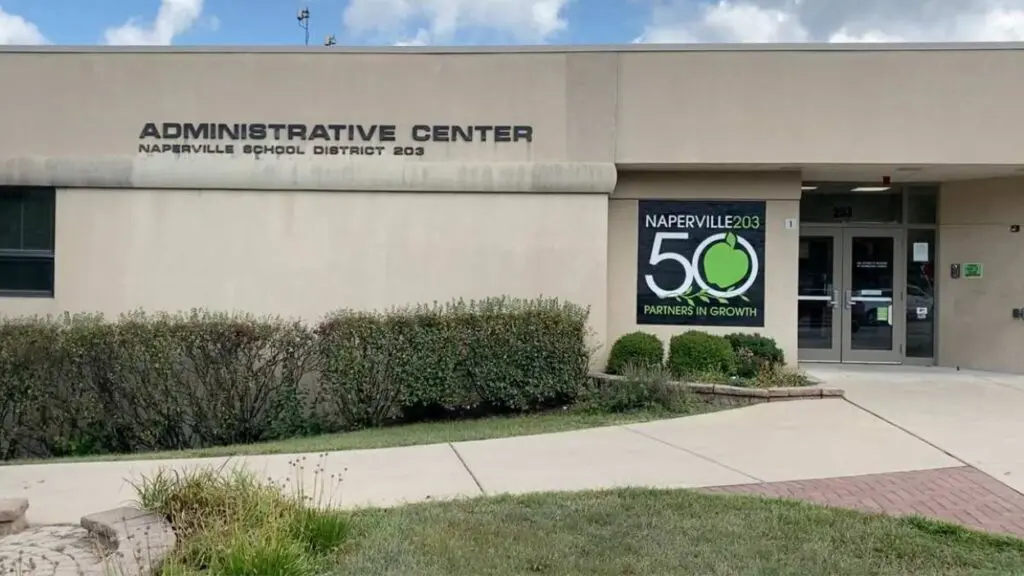
Naperville School District 203 remained at the head of the class in the recently released 2025 Illinois Report Card.
According to administrators, Naperville 203 ranked in the 99th percentile of all statewide unit districts, or those providing instruction across all grade levels, which is the metric district officials use to gauge performance within the state.
A look at key figures within this year’s state report card
Six of Naperville 203’s elementary schools — Maplebrook, Meadow Glens, Mill Street, Naper, Prairie, and Scott — were deemed “exemplary,” which is the highest ranking within the report card. All other schools within the district were within the second-tier “commendable” category.
None of Naperville 203’s schools were within the third-ranked “targeted,” fourth-ranked “comprehensive,” or bottom-ranked “intensive” categories.
“When we look at these results, we’re very proud of the work that’s going on in our district, and the work that’s happening in our classrooms across the school district right now,” Superintendent Dan Bridges said at a Monday, Nov. 3, board of education meeting. “I think the results really exemplify the hard work that’s being put in.”
Bridges provided an explanation of the 99th percentile ranking assertion as he and other district officials provided a deep dive into the data at the recent board meeting.
“That’s whether you’re looking at IAR (Illinois Assessment of Readiness) or ACT — when you put that all together, we’re at the 99th percentile rank,” Bridges said. “That’s remarkable. If you need evidence that we’re exemplary, that’s something you can continue to say.”
Patrick Nolten, Naperville 203’s assistant superintendent for assessment and accountability, said the district continues to outpace state averages in a number of metrics.
In terms of overall proficiency percentages within the IAR, Naperville 203 has attained an 82% in the core curricular area of English Language Arts, compared to the state’s 53% average in the metric in the same subject. In math, Naperville 203 has attained 71% proficiency, compared to the state’s 39% average.
Proficiency scores on the ACT showed similar results. In Naperville 203, 78% of students achieved proficiency in the most recent exam in ELA, compared to the state average of 52%. In math, 72% of Naperville 203 students were proficient on the ACT, compared to the statewide 39% average.
A deeper look at some of the district’s other data
In his presentation to the Naperville 203 board, Nolten also took a deep dive into the district’s different demographic groups, and how each performed from the perspective of student growth.
“I can tell you, just looking at this, eyeballing it, we don’t have concerns about particular groups,” Nolten said. “There’s some variation, but everybody’s well above 50(%).”
Naperville 203 officials in recent years have placed more emphasis on student growth, rather than merely meeting proficiency benchmarks, in a move touted as helping ensure all students are growing academically from one year to the next.
One student group, English Language Learners, has continued showing encouraging results as Naperville 203 has ramped up its programs and curricular offerings for multilingual students. This year’s state report card data has revealed a 22% progress-to-proficiency rate within this subgroup, compared to the state’s overall 7% rate.
“That means we’re releasing 22%, or one in five students, from needing EL support annually, compared to 7 out of 100 for the state of Illinois,” Nolten said. “We’re doing quite well — three times the state level.”
Other key numbers of note within the report card include:
- 96% high school graduation rate
- 96% of students in grade 9 are considered “on track”
- 94% student attendance
- 86% of Naperville 203 graduates are enrolled in post-secondary education
Double-digit chronic absenteeism rates a concern
Naperville 203 board members weighed in on the report card data at the recent meeting. A number of specific questions and comments were shared during the lengthy discussion.
One data point — Naperville 203’s 15% chronic absenteeism rate — was touched on during the deliberations. The average across Illinois in the same metric is 25%. But pre-pandemic, Nolten indicated Naperville 203 frequently was “in the single digits” in the metric.
“I want to understand more about what’s being done about the chronic absenteeism, because when I looked at last year’s presentation, our number (this year) is almost identical,” board member Kristine Gericke said. “I know it’s a tough one, but what are we employing to kind of help bring that number down?”
Mark Cohen, deputy superintendent for high schools, said there are a number of complex issues that play into the data point.
“It’s very individualized,” Cohen said. “It’s not a very high bar to cross for some of our students to be considered chronically absent, especially if they have medical concerns. If a parent takes a vacation during the middle of the year, because of the timing of a parent’s job, with their students, that puts (the students) dangerously close to that threshold.”
Jayne Willard, assistant superintendent for curriculum and instruction, said Naperville 203 takes an individualized approach to addressing chronic student absenteeism. She indicated there are school-level supports in place, with social workers, guidance counselors, and student advocacy specialists assisting in the process.
“They are communicating constantly with those families,” Willard said. “They really have a pulse on who those kids are.”
If you have a story idea, send us a tip!