
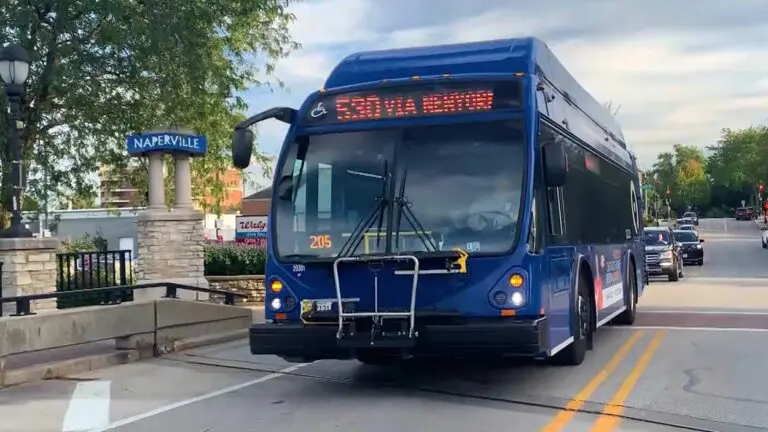
It was a long and winding path, but after a series of twists and turns, the upcoming Pace Bus budget is on track for a solid level of service in the years ahead, officials have announced.
At a DuPage County Board meeting Tuesday, Dec. 9, Chair Deborah Conroy and Pace Board Director Thomas Marcucci discussed the status of Pace Bus’ financials after the General Assembly’s adoption of Senate Bill 2111 late last month.
Drastic budget cuts mitigated with legislation
SB 2111, which is to take effect June 1, 2026, encompasses a number of transit-related provisions within it, including changes to the governance and operating budget structure of the Chicago Transit Authority.
Conroy said she lobbied lawmakers in Springfield and implored them to provide provisions that would help ensure mass transit services such as Pace Bus remain on a solid footing in the years ahead.
“It was quite a journey, and there was a lot of give-and-take,” Conroy said amid a lengthy discussion of Pace’s future at the board meeting. “We will continue the fight for the collars — and DuPage, in particular — to get a fair say, in terms of how money is spent.”
Prior to the adoption of SB 2111, Pace Bus was facing what Marcucci described as a “doom and gloom” budget for the upcoming fiscal year. Fare increases, route cuts, and fewer ADA-related accommodations were all a part of the proposals considered.
Legislation positions Pace for long-term success, Marcucci says
The provisions encapsulated within SB 2111 help position Pace Bus for long-term success, Marcucci said in his presentation to the DuPage County Board.
“We went from a mandated 10% fare increase six weeks ago to, ‘We are not allowed to raise the fares until at least after Jan. 1st, 2027,’ which we’ll have to wait and see how that develops over time,” Marcucci said.
At its core, Marcucci said the terms outlined in SB 2111 provide reliable, dedicated funding streams.
“We now have a stable, dedicated source of funding that I believe will carry the 6-county transportation system deep into the future,” Marcucci said. “This is not a Band-Aid. This is a sea change in how we are going to be funding public transportation, coming into the future.”
A look into the financial figures for the upcoming fiscal year
Speaking to the amended budget, with SB 2111 in play, Marcucci said the Pace Bus budget now is set at $372 million for the coming year. Prior to the legislation, budget figures hovered around $348 million.
Pace Bus’ ADA budget is also expected to increase in the coming year, with $361 million earmarked toward it, rather than the previously projected $296 million.
“That’s going to provide a lot of service, and we’re very pleased about that,” Marcucci said.
Speaking to the more immediate capital plans for Pace Bus, Marcucci said, “We’re going to buy nine all-electric, full-size buses. We’re going to buy 13 hybrid buses.”
Long-term, Marcucci said Pace Bus’ goal is to go fully electric by 2040, though achieving that goal will require significant cash infusions and a contribution from the federal government.
“In a very, very round number — and this is conservative — it’s $1 million a parking spot to bring electricity into that garage and then distribute it out to the different parking spots and then do that safely,” Marcucci said. “That’s a huge part of our capital program, going forward.”
As of the county board meeting, Gov. JB Pritzker had not signed SB 2111 into law, but Marcucci said he was confident the action would take place soon.
If you have a story idea, we want to hear from you!