
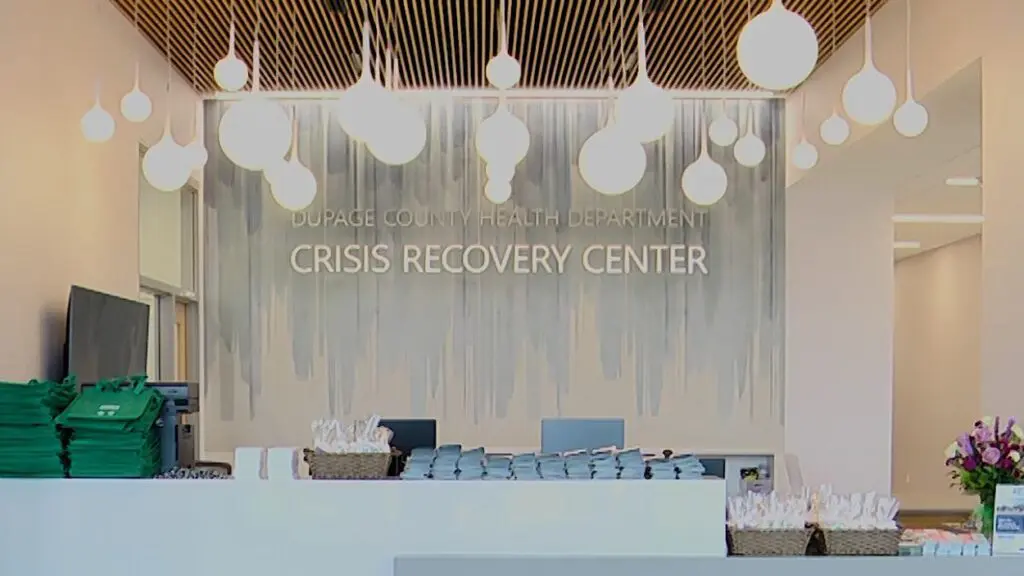
Staff within the DuPage County Crisis Recovery Center made a total of 745 onsite referrals in the final four months of 2025, according to a recent report. Local health and elected officials lauded the statistic, declaring it a success, during a recent review of the venue’s launch.
“We’re only four months in, and the early signs are incredibly encouraging,” Adam Forker, director of the DuPage County Health Department, said as he and other officials gave a report on the center’s debut at a County Board meeting Tuesday, Jan. 27.
The new $25.8 million facility, located at 115 N. County Farm Road in Wheaton, officially opened its doors Sept. 2, and has been touted as a first-of-its-kind amenity.
“The team is delivering exactly the kind of responsive care that our members deserve in their greatest moments of need,” Forker said. “I believe the data shows a strong start.”
Digging into the numbers and what they mean
The health department report focused on statistics through Dec. 31. The figures indicate most of the Crisis Recovery Center’s recipients (566 people) were within the 18-65 age bracket. A total of 139 youth came to the center for services, and 40 older adults, age 65 and up, did as well.
“Traditionally, we did not see youth coming on our site,” Lori Carnahan, deputy executive director of the DuPage County Health Department, said. “It’s really great to see that they’re realizing there is a new place to go and receive the treatment that they need.”
Nearly two-thirds — 61% — of the onsite assessment referral sources are coming from the recipient or a family member, according to department data. Community providers made 13% of the referrals in the center’s first four months, and schools provided 9%.
Other sources included police and EMS (6%), the 988 crisis hotline (5%), hospitals (4%), and the county jail (2%).
“The communication that we’ve put out into the community is being heard, and it really is being shared because we are starting to see those pretty consistent numbers over time of many, many different referral sources,” Carnahan said.
Outpatient care has been a key cornerstone of the center. To that end, department officials have indicated 95% of all assessments in the first four months of the center’s operations resulted in such community care options as crisis residential placement, pods, or living in a home with a safety plan in place.
“That means that people are coming in, they’re receiving services through triage through our youth or adult pods, or our crisis residential program,” Carnahan said. “They’re going home with a safety plan, with wraparound services, and a really good plan for care.”
The other 5% of recipients were at a higher level of care that included such referrals as inpatient psychiatric care. Carnahan indicated 2% of the recipients requiring the elevated support were admitted to an emergency room.
Center described as ‘a jewel in our county’
County Board member Sam Tornatore, who represents District 1 and also is president of the DuPage County Health Department board, described the Crisis Recovery Center as “a jewel in our county” and noted it is gaining widespread recognition within and beyond DuPage.
“Without this board, and Chair (Deborah) Conroy’s support, we wouldn’t have been able to build it, we wouldn’t have been able to continue the sustainability of it, now and in the future,” Tornatore said.
Conroy who championed the initiative throughout the planning and development stages, said she was pleased with the preliminary results.
“In the months running up to the ribbon cutting, I would frequently say that the CRC would be a game-changer for our residents,” Conroy said. “I think our early results demonstrate this much-needed facility. It is positively and significantly impacting clients’ lives.”
Other County Board members gave accolades to center staff for making a positive impact on the region during a question-and-answer period at the recent meeting.
“I’ve had so many people, over the course of the past few months, come up to me and say that it is not only incredible what we are doing here in DuPage, but we are setting an amazing example.” District 2 board member Andrew Honig said.
Looking ahead, and financial planning
As with any amenity, dollars and cents are a key component to the center and its long-term viability within DuPage. County officials emphasized this point at the recent meeting.
“We talk a lot about, of course, the financial sustainability of the center, and, really, that plan builds on the same foundation that has always supported our behavioral health work,” Forker said.
In terms of the center’s balance sheet, Forker added, “We bill for the clinical services we provide, we pursue competitive grants, and we use the local tax support to stabilize our highest priority needs, when needed.”
DuPage Health Matters, the department’s 501(c)(3) philanthropic arm, raised $535,405.58 in 2025, Forker said, and a vigorous fundraising strategy is getting underway this year to build off last year’s momentum.
If you have a story idea, send us a tip!