
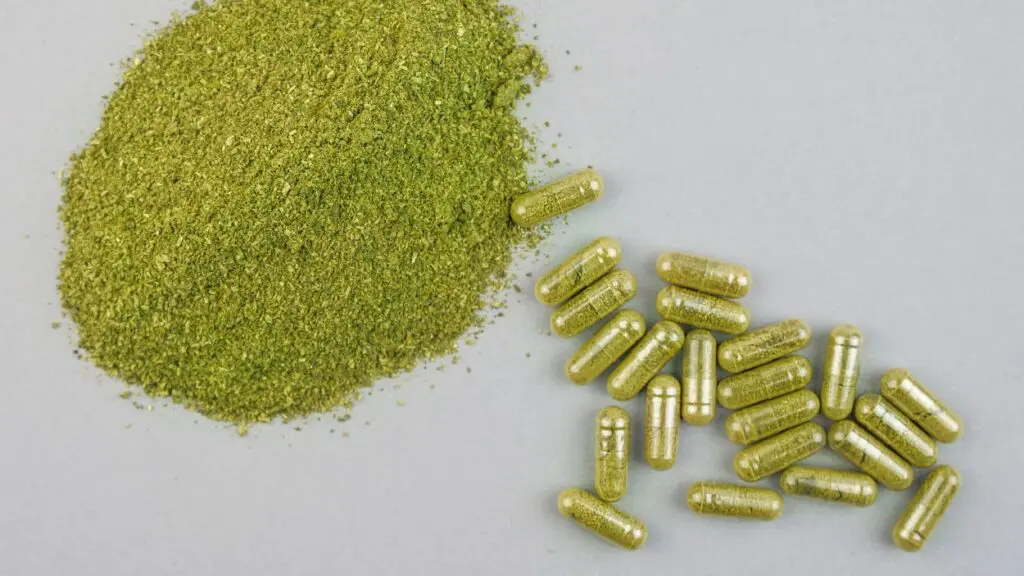
Beginning next month, Naperville-based retailers will no longer have the authority to stock and sell kratom products.
The Naperville City Council on Tuesday, Sept. 1, voted, 8-0, in favor of an ordinance prohibiting the retail sale of the drug, which is derived from the leaves of a tropical evergreen tree that is native to Southeast Asia.
Details behind the sales ban
According to a memo from Jennifer Bonner, senior assistant city attorney, the retail sales ban will go into effect Oct. 1, “ensuring city staff have adequate time to notify affected retailers.”
While local merchants will soon be prohibited from offering kratom products for sale, the ordinance does not prohibit the actual use of the drug within Naperville.
Bonner in her memo noted the U.S. Food and Drug Administration has released “multiple warning letters” about kratom — particularly the synthetic 7-OH variant that offers a concentrated form of the product that is a higher dosage than its naturally occurring counterpart.
In her analysis, Bonner pointed to assorted studies and statements from organizations about kratom. Product labeling, addictive potential, and ease of minors obtaining the product were among some of the concerns raised.
Kratom advocates continue speaking out
The Naperville City Council had a first reading of the ordinance last month, but tabled any action at the time to gather additional information.
Kratom advocates implored the council to consider regulation in lieu of an outright ban of the sale, drawing a sharp distinction between the naturally occurring forms of the drug and the synthetic variant.
Dr. Heidi Sykora of Wauconda spoke to the council last month and returned at the recent meeting to speak in defense of kratom. Taking a natural form of the drug, she said, has had a positive impact on her life.
“Natural kratom is the only thing that has restored my functional ability, after a lifetime of painful congenital neurological conditions,” Sykora said. “Pharmaceuticals caused life threatening side effects. Natural kratom does not intoxicate me or impair me. It simply reduces my pain — enough that I can exercise and stretch.”
Allison Smith of the Washington, D.C.-based Global Kratom Coalition Organization also spoke to the council and said the synthetic forms of the drug are the root cause of the problems that have occurred — not the natural botanical products that are on the market.
“In recent years, manufacturers have begun producing highly addictive substances for financial gain,” Smith said. “It is in the interest of these drug manufacturers to both confuse and conflate regulators and consumers.”
Craig Katz is government relations and compliance manager with MNG Brands, a 55-store chain that operates under the CBD Kratom nameplate. He gave the council a retailer’s take on the sale of the product.
“As a company, we have self-regulated since 2014, when we opened up our first store in Chicago,” Katz said. He later added, “To call the products that we sell ‘gas station heroin’ is, frankly, insulting to everybody in the industry because that’s just not what it is.”
Proponents of sales ban give a different take
The council also received comments from people in support of the sales ban. Many shared stories of loved ones who suffered from addiction.
Todd McCartney provided written testimony to the council. In it, he chronicled the struggles of his son, William Brandt McCartney, who died in June.
“My son was hurting and struggling bad, in his room all day, in the dark,” McCartney wrote. “He was very open about his addiction to kratom. He told us that he would go to the local gas station or vape store, less than 2 miles away, to get kratom during the day.”
The council also received written comments from Susan Eppard, who indicated her son, Matthew Eller, died at age 22 “from the toxic effects of whole-leaf kratom.”
“Matthew was a healthy young man with no underlying medical conditions,” Eppard wrote. “His autopsy and toxicology reports were entirely clear of prescription medications, illegal substances, or alcohol. His cause of death was explicitly ruled as the toxic effects of mitragynine, the primary alkaloid found naturally in the kratom leaf.”
In addition to the public comments, Naperville Police Chief Jason Arres last month gave his take on kratom use within the community. He said he considered it more of a public health and consumer safety issue than a crime-related one.
“What I would draw attention to, from the police perspective, and where it lines up with the public health perspective, is, in the last four months, we’ve had four overdoses, and one fatal, that a coroner attributed to kratom usage,” Arres said last month. “We had another mental health-related call, where someone was taking kratom, so we are seeing the calls, but not necessarily criminal.”
Council explains rationale behind supporting retail ban
At the conclusion of deliberations, the city council voted, 8-0, in support of the ordinance banning the sale of all kratom products at retail establishments in Naperville. Councilman Patrick Kelly was absent.
Councilwoman Supna Jain was one of multiple elected officials who indicated they thought deeply about their vote before coming to their conclusion.
“I see one of my primary duties as protecting our most vulnerable population, which are our students, who are not able to distinguish between what is harmful because the federal regulations have not gotten up to speed,” said Jain, who indicated her final vote was predicated on a belief the costs of continued allowances of kratom sales outweighed the benefits.
Councilman Ian Holzhauer shared similar sentiments during the deliberation. Holzhauer said he reached out to a number of experts — including mental health professionals — before deciding to support the ordinance.
“We’ve not been afraid in the past to step in when it’s public safety that’s an issue, so I’m going to be supporting the ordinance,” Holzhauer said.
Councilman Josh McBroom said he would have preferred a different iteration of the ordinance, but said he would support it as the sole option of the evening. McBroom also noted local business owners have not spoken out about the planned prohibition.
“I would have preferred to have regulated it and not do an all-out ban,” McBroom said. “But if this is the vote tonight, ban or not, then it’s not a sword I’m going to die on either.”
At the conclusion of the deliberations, Mayor Scott Wehrli expressed appreciation to everyone who weighed in on the issue.
“You have been heard, and you are all a part of the public record,” Wehrli said. “The mayor’s office and the city council has received impassioned communications on both sides of this issue, and I do not doubt the sincerity of anyone who’s testified at the liquor commission or before this council.”
Ultimately, Wehrli said he believed the ordinance as written is the best path forward for Naperville because standards currently are not in place in higher levels of government and methods of distinguishing between natural and synthetic forms of kratom are not foolproof.
“Naperville can’t build a laboratory to verify the purity of what’s sold here,” Wehrli said. “Even if we could, the overdose risk would still be there.”
Stay in the know – sign up for our daily news update!