
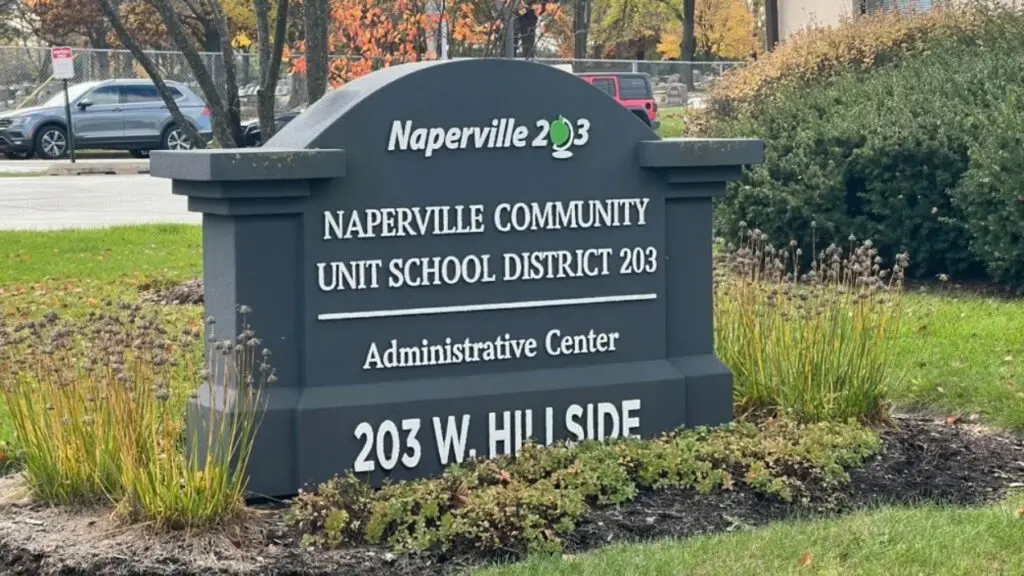
A refreshed long-range look into Naperville School District 203’s finances reveals continued budget shortfalls if actions are not taken to trim the expense side of the ledger.
In the current fiscal year 2027 budget, reflective of the 2026-27 school year, Naperville 203 officials have on record a $3.975 million deficit for core areas of the budget, including the educational fund that fortifies day-to-day classroom instruction.
If a status quo approach remains in place, the district’s deficit could balloon to $24.429 million by FY 2032.
A look at the new set of figures
Michael Frances, Naperville 203’s chief financial officer, provided a high-level overview of the state of the district’s finances at a board of education meeting Monday, Nov. 16.
“Each year, we update our five-year financial model to guide operational recommendations, establish the annual tax levy, and run ‘what if’ scenario analyses throughout the year,” Frances said.
District officials discussed Naperville 203’s forthcoming financial shortfalls a year ago and began looking at a number of budget cutting options. Teaching position reductions through the state’s Reduction in Force (RIF) process were considered as one of the options, but ultimately were voted down in March.
Naperville 203’s current amount of reserve cash in the fund balance for such areas of the budget as educational, operations and maintenance, and transportation clocked in at $66.11 million at the start of the current fiscal year in July. With the current deficit in the mix, the fund balance is poised to decrease to $62.134 million by next June.
“As we are projecting operation trends forward, compounding expenditure growth, with no changes, will cause reserve funds to decline rapidly,” Frances said.
Without a change on either side of the ledger, Frances said Naperville 203 is projected to exhaust all of its fund balance by FY 2032. The current year fund balance comprises 17% of the broader budget.
Salaries make up the majority of the current fiscal year budget, accounting for $238.664 million of the $370.132 million in expenses. Benefits, at $59.498 million, is the second largest expense.
Costs continue rising, but levy caps in effect
In his presentation, Frances said a persistent imbalance of expenditures outpacing revenue is driving the deficits within the financial forecast.
Property taxes make up 86% of Naperville 203’s revenue, Frances said. Illinois’ Property Tax Extension Limitation Law caps the amount of levy increases at the rates set by the national consumer price index, which is an estimated 2.7%, relevant to the 2026 tax levy that will be voted on next month.
Another challenge, Frances indicated, comes by way of some of the state financial contributions for required categorical services, such as transportation and special education.
“It’s a service we have to provide, and the state is supposed to fund that at 80% reimbursement,” Frances explained.
In recent years, Frances said the state has been providing less than 80% reimbursement for the costs incurred for such services.
Frances also said a number of broader factors outside the district’s control have been weighing on expenses, such as fuel costs.
A variety of factors go into formulating the budget forecasts, he said, including a historical look at the district’s financial performance and a review of Illinois’ evidence-based funding laws that determine how much districts receive in state dollars each year.
Board members share thoughts on next steps
In speaking to next steps, Frances said, “We recommend that the board direct administration to develop a multi-year deficit reduction strategy, evaluating operational efficiencies and revenue structure to ensure long-term fiscal stability.”
At the recent meeting, a number of board members gave their take on the refreshed set of numbers, and shared several possible actions that can be taken in the immediate future.
“I think we really need to talk to Springfield, because they’ve really put us between a rock and a hard place with these mandates that they’re not funding, and we’re working within a cap,” Holly Blastic said.
Kristine Gericke shared similar sentiments: “We need the community’s help to put pressure and say, ‘We pay taxes to the state. Why isn’t the state upholding its end of the bargain?’” she said.
In terms of the district’s budget itself, Amanda McMillen said a look at multiple scenarios would be beneficial in future decision-making processes.
“What would be helpful is to see at least two or three options that we can kind of choose from, ideally beforehand, to really weigh what are the pros and cons and help us ensure that we’re really thinking about the ripple effects,” McMillen said.
Board President Charles Cush said a look at “realistic buckets” that could be cut would be a good starting point for future decision-making.
“There are probably some things that are just off the table, in terms of the ability to even consider cutting,” he said.
Stay in the know — sign up for our daily news update!