
Liquor commissioners unanimously passed a motion at a meeting on Thursday recommending that the Naperville City Council ban the local retail sale of kratom products.
The motion followed presentations from Fox Valley Institute, Living Oaks Behavioral Health, and 360 Youth Services, as well as the testimony of a Naperville resident recovering from a kratom addiction.
Under-regulated Kratom use
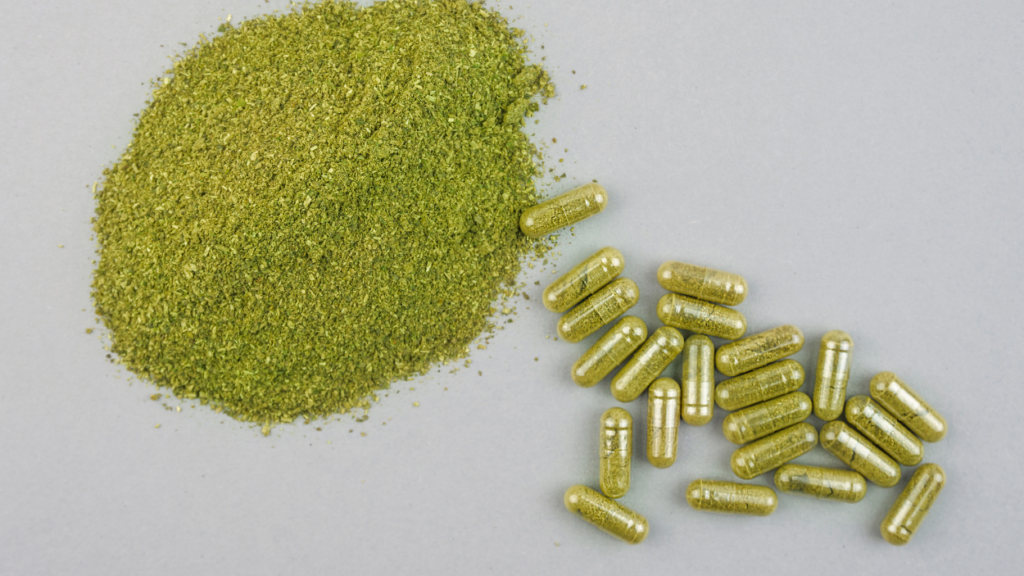
Kratom is derived from tropical evergreen trees native to Southeast Asia. The leaves can be brewed as a tea, crushed into powder, smoked, snorted, or taken as pills.
At Thursday’s meeting, speakers presented general information about kratom, saying it holds risks as an under-regulated substance and how it is labeled and marketed.
The US Drug Enforcement Administration said that at low doses, kratom acts as a stimulant, but in large amounts, it can produce opioid-like effects. Though it has been used to self-treat pain, anxiety and depression, and opioid withdrawal, the US Food and Drug Administration has not approved kratom for medical use.
Kratom leaves contain two psychoactive ingredients: mitragynine and 7-hydroxymitragynine (7-OH). Some kratom products have been synthesized in a lab to boost the effects of kratom and give stronger effects.
Kratom products can be found for sale in smoke shops and gas stations, and buyers must be over 21 to purchase. The presenters requested that the commission consider stricter restrictions, saying the marketing for the concentration of 7-OH in these products is often misleading, and the addictive effects of kratom are not widely known.
Alexandra Pochron, who works at Fox Valley Institute, said that while treating kratom addicts, she found users often didn’t know the addictive effects of the substance.
“The people I treated for kratom addiction all fit the profile common to citizens of Naperville. They were professionals, parents, valued community members, intelligent, disciplined, and began using kratom products believing they were safe,” Pochron said.
Matt Cassidy from 360 Youth Services talked about the dangers of marketing kratom products as health supplements and the risk this poses for young adults, especially.
“Very often these products are being marketed as increasing focus, energy, pain, anxiety. We see this with our youth, especially in high-achieving areas, where school is a big part of life,” Cassidy said. “We see that kind of marketing often times tiptoeing right up to making a health claim, but really sharing that it’s a health or an energy supplements, using that kind of language, ‘herbal,’ so it sounds safe.”
Naperville citizen shared personal recovery story
Ashley Ware, a Naperville resident and mom of four, shared how she became unknowingly addicted to kratom.
Ware first heard about kratom on a health and wellness podcast in 2022. The podcast advertised a kratom-based drink called Feel Free, marketed as an alcohol substitute and herbal supplement.
After trying the substance, Ware shared that she was “hooked immediately” and had sometimes as many as five 2-oz bottles of the drink daily.
Using the drink for two years, Ware described having “significant physical and mental health issues.” She said her skin started to turn green, and she lost weight. She had irregular heart palpitations, digestive system issues, mood swings, and paranoia.
“I still didn’t fully understand that it was an addictive drink. I just thought that it was like drinking coffee every morning,” Ware said.
Ware and her husband decided to do more research into kratom and learned of its addictive, opioid-like effects. The next day, on April 15, 2025, Ware stopped drinking Feel Free and felt withdrawals immediately. She decided to check into Endeavor Health Edward Hospital for detox.
“They welcomed me in with open arms but had never heard of [kratom],” Ware said. “They immediately treated me like a heroin addict.”
“There’s so many products that anybody can take, and anybody could get addicted to. For me, with [Feel Free], it’s the way that it’s marketed,” Ware told NCTV17. “People assume it’s a natural supplement, so to bring awareness to reading the labels, to really knowing the leaf that is in each product and knowing the ingredients.”
Kratom regulation history in Naperville
In Naperville, the local retail sale of kratom is banned to anyone under the age of 21, and possession of kratom by individuals under 18 is prohibited. In 2019, the city council adopted this ordinance in alignment with the Illinois Kratom Control Act.
At a liquor commission meeting on Sept. 4, 2025, 360 Youth Services presented information to the liquor commission, raising awareness of kratom and voicing concerns that it was underregulated, specifically addressing the risk of young people obtaining the substance. At that meeting, 360 Youth Services suggested stricter restrictions on kratom sales.
Global Kratom Coalition suggests regulation
In a written comment to the commission, the Global Kratom Coalition advised against a full ban on all kratom products, informing the liquor commission of a decision made by the DEA last week.
On July 6, the DEA published a Notice of Intent to temporarily place 7-OH above a specific threshold, along with other derivatives, into Schedule I of the Controlled Substances Act. The notice does not cover botanical kratom with traces of 7-OH below the allowed threshold. Once the temporary scheduling orders are in effect — on or after August 5 — the manufacture, distribution, sale, and possession of 7-OH products above the specified threshold will be illegal.
Ahead of the notice, the Department of Health and Human Services said there was no medical use for 7-OH and that it had a high potential for abuse.
In the comment, Allison Smith, global affairs director for the coalition, noted the distinction made by the DEA between synthetic 7-OH products and traditional kratom leaf products. Smith recommended that Naperville follow the federal decision to ban 7-OH products above this threshold.
“This presents an opportunity to ensure any local policy complements federal action rather than duplicating or conflicting with it,” Smith wrote. “Rather than treating all products sold under the kratom label the same, Naperville can focus its efforts on the products the DEA has now identified as posing an imminent hazard to public safety.”
Commissioners pass motion 5-0
Despite the coalition’s recommendation, Commissioner Tony Signorella moved to recommend that the city council ban the retail sale of all 7-OH and kratom products in Naperville.
Commissioner Steve Chirico noted that at the city council meeting in 2019, when the kratom ordinance was first adopted, there was testimony of medical use for the substance.
“There very well could be a medical benefit to this product, but if that’s the case, it should be prescribed by a doctor, a medical doctor, or at least, at minimum, be much like medical cannabis, controlled in a regulated way,” Chirico said. “It’s about time that we made a move on this. I’ll support that motion.”
Mayor Wehrli also voiced his support.
“I think it’s a very appropriate action that the commission is considering right now,” Wehrli said. “It’s really a scary health risk for our community. I think there is immediate action that we need to take in our city to protect our residents.”
The motion passed 5-0. The Naperville City Council will hear the liquor commission’s recommendation at its August 18 meeting.
Stay in the know—sign up for our daily news update!