
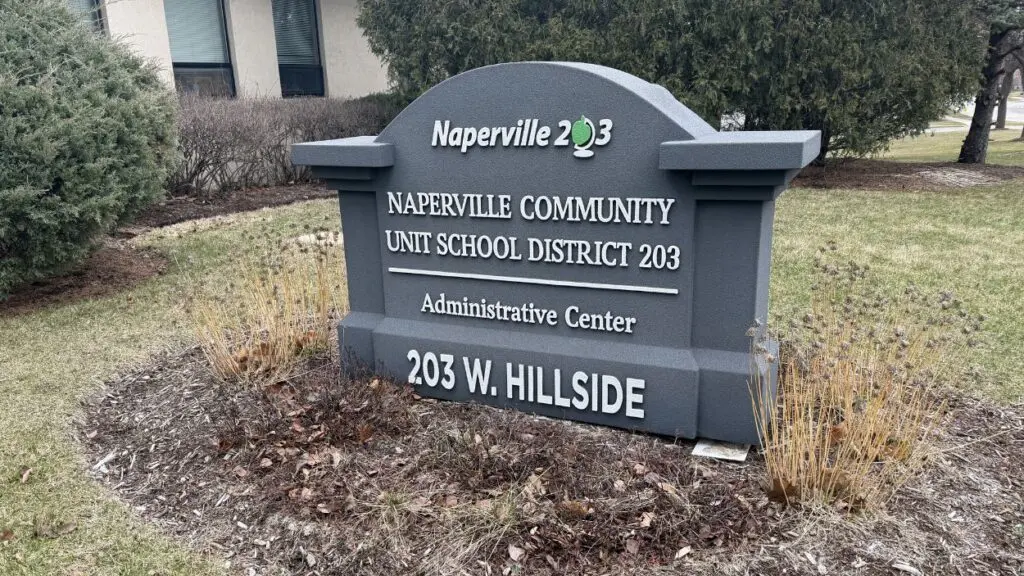
The term “structural deficit” was used several times during a review of Naperville School District 203’s proposed fiscal year 2027 budget at a recent board of education meeting.
District officials presented a draft of the budget for the 2026-27 school year on Monday, May 4. It will be hashed over across multiple board meetings before adoption is scheduled prior to the start of the new fiscal year on Wednesday, July 1.
Budget proposal trims deficit from roughly $12.4 million to $4 million
Michael Frances, Naperville 203’s chief financial officer, combed through details of the budget at the recent board meeting. Last fall, Frances warned of a looming deficit as pandemic-era recovery funds dried up.
In February, a projected $12.39 million shortfall in the funds for day-to-day operations was discussed as a possibility if no budget cuts occurred. A number of cuts did ultimately occur, and Frances’ latest budget proposal points to a $3.975 million deficit within the district’s funds for day-to-day operations.
The deficit correlates to an anticipated $366.159 million in total revenue for the district’s FY 2027 day-to-day operations funds, compared to anticipated total expenses of $370.135 million.
The board initially had called for a balanced 2026-27 school year budget, which would have necessitated teacher layoffs, but the board voted against doing so in March after a lengthy public comment period.
Speaking to the still-present, but trimmed deficit, which will be made whole through allocating reserve dollars in fund balance, Frances said, “This allows for a more gradual transition that protects our core student programming, while we work to close this gap over the coming (budget) cycles.”
No new initiatives are built into Naperville 203’s FY 2027 budget. Whittling down the initial deficit that was north of $12 million was achieved through a number of measures, Frances outlined in his presentation.
Examples include $1.65 million in savings in information technology, which Frances attributed to “aggressive renegotiation” of installation contracts, among other measures. The district also has managed to save $1.2 million from initial projections in the area of transportation.
Staff reductions still are a part of the upcoming school year’s financial plan, though they are being achieved through attrition and retirements. Plans call for the districtwide elimination of 59 full-time equivalency positions across multiple categories.
Pivoting from pandemic recovery era to sustainability era
Frances’ budget presentation also delved into the confluence of factors that led to budget shortfall projections for the upcoming fiscal year and beyond.
The administrator described Naperville 203’s fiscal realities ahead as a pivot from what he described as the “pandemic recovery era” to a “sustainability era” that will lean heavily on core operations and local resources for funding.
“I want to begin by saying clearly that this budget cycle has been unlike any other in recent history,” Frances said. “It marks a critical turning point in our district as we pivot away from the temporary financial landscape of the last few years and move toward a more sustainable, long-term fiscal model.”
Speaking to the guiding mantra in crafting the new budget, Frances said, “FY27 is a pivot back to stricter long-term fiscal discipline.”
The call for budgetary belt tightening is expected to persist in the upcoming school years, based on current projections.
“While we have made significant strides, the work continues,” he said. “The nearly $4 million structural deficit underscores the critical need for unyielding fiscal discipline. Additional reductions will be necessary in future cycles to fully align our expenditures with our localized, limited ongoing revenue.”
As is the case with any budget proposal, Frances also noted there are a litany of unknowns that could ultimately impact the district’s bottom line. Rising fuel costs linked to the war in Iran, for instance, could further strain the expense side of the ledger.
Challenges aside, Frances said Naperville 203 remains on a solid financial footing.
“Because we have a sufficient fund balance, we can weather a short-term storm,” he said of any unknowns that might crop up and alter current projections.
Board members weigh in on budget draft, timeline discussed
The board and Naperville 203 administrators will continue discussing the 2026-27 school year budget over the course of multiple meetings, with the recent May 4 presentation being the first glimpse into the document. It is fully detailed in a 56-page budget book.
Several board members, including Amanda McMillen, weighed in on the budget plan during the first-blush review.
“I do appreciate all of the efforts that were made to streamline services and reduce duplicative costs,” McMillen said. “I know that’s difficult work, but thank you.”
In a big picture sense, board member Marc Willensky expressed confidence in the projections presented within the budget document.
“Every budget is going to have some level of estimation,” Willensky said. “It’s not going to be 100% correct. We accept that because it gives us the guidance and the direction that we need to plan financially for the upcoming fiscal year.”
State law requires all school districts have a finalized budget in place by Sept. 30. Naperville 203, however, has long had a practice, borne out of a board policy, to have it finalized by late June before the new fiscal year starts.
Further discussions of the budget are planned at board meetings on Mondays, May 18, June 1, and June 15. A statutorily required public hearing on the budget proposal also is scheduled for Monday, June 15.
If you have a story idea, we want to hear from you!