
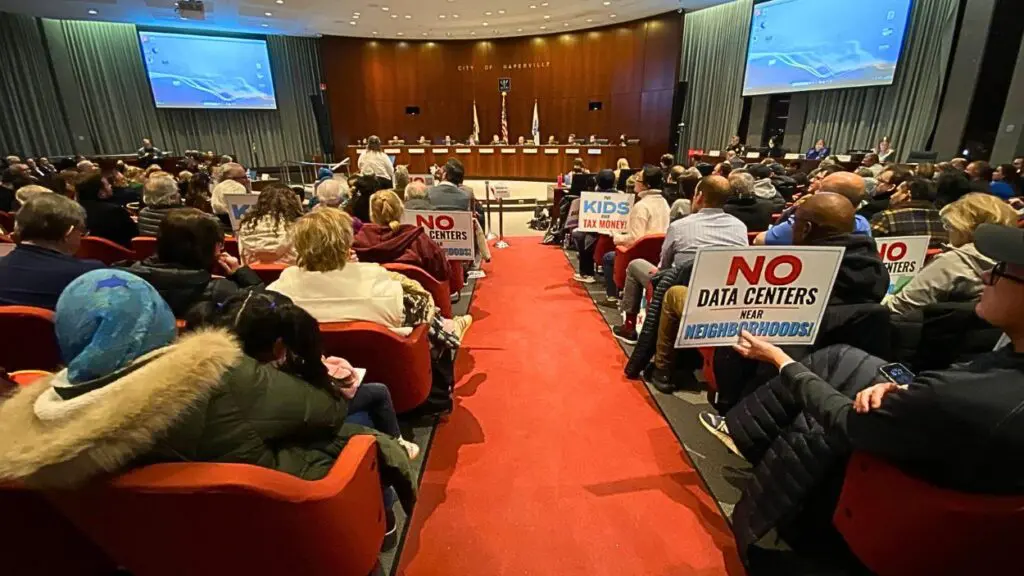
Against the backdrop of a packed room of residents and a number of impassioned signs, the Naperville City Council voted against a proposed data center at the site of the former Nokia, or Alcatel-Lucent, building along the I-88 corridor.
The council at its Tuesday, Jan. 20, meeting ultimately voted, 6-1, against granting Karis Critical Data Center a conditional-use permit and an accompanying owner’s acknowledgement and acceptance agreement. Both documents are necessary to construct the facility on a 40.87-acre parcel, located at 1960 Lucent Lane.
Councilmembers Mary Gibson, Ian Holzhauer, Supna Jain, Patrick Kelly, Ashfaq Syed, and Benny White voted to deny the necessary documents, while Councilman Josh McBroom voted in support of approving the permit and agreement. Mayor Scott Wehrli and Councilman Nate Wilson abstained from voting on the denial, stating a desire for more information.

Karis representatives present appeal to continue review
Plans for the Karis data center facility were first presented to city officials in September. The Naperville Planning and Zoning Commission held multiple meetings and public hearings this past fall before ultimately voting, 8-1, with a favorable recommendation.
The project proposal subsequently advanced to the decision-making city council. At the Jan. 20 council meeting, Karis representative Russell Whitaker III indicated a series of additional modifications were on the table for consideration as the company sought to reach a compromise with city officials.
Whitaker, a partner with the Naperville-based law firm of Rosanova and Whitaker, has been providing Karis with legal representation since the proposal’s inception and has been serving as the project spokesman at city meetings.
Speaking to the latest project proposal before the council, Whitaker said Karis was prepared to lower the size and scope further, with less energy output and a smaller physical footprint on the property.
The latest proposal called for a 24-megawatt load within one facility, which is a reduction from the 36-megawatt load the Planning and Zoning Commission approved in November. Initial plans in September called for a 72-megawatt load across two facilities.
“This represents another 33% reduction in scale — that’s a 33% reduction in scale after the city’s planning staff found that the project met standards for conditional-use,” Whitaker said. “To be clear, with this new reduction in scale, there is corresponding reduction in the square footage of the building, and the equipment necessary to operate the data center, including both generators and cooling equipment.”
Whitaker defended the company’s latest revision, which was presented late last week, indicating it was the culmination of collaboration with city officials.
“There is no grand conspiracy,” Whitaker said, defending criticisms of the timing of the amended proposal. “I know, oftentimes, we go searching for rationale, and, sometimes minds get fanciful and they’re looking for an extraordinary reason of why we made a change at the last minute.”
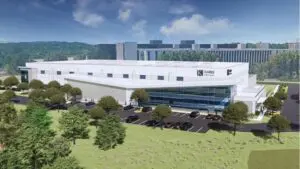
Rendering of data center, image courtesy Karis Critical
Majority of council not convinced conditions met
A number of the councilmembers voting against it said they were not convinced Karis representatives met the burden of proof thresholds to demonstrate all of the conditions were met to warrant approval of a permit.
Kelly said he had “very real, and, I believe, legitimate concerns” about the data center and its placement in close proximity to neighboring residential areas.
“While there is little argument that data centers are needed to facilitate the smooth operation of modern technologies, a data center is not necessarily needed at this particular location,” Kelly said.
White shared several reservations, including documentation Karis presented in response to concerns of adverse property value impacts.
“While I have reviewed the housing trend report that was submitted, I am not convinced that is sufficiently demonstrates that there will be no adverse affect on property values in the surrounding neighborhood,” White said.
Several councilmembers wanted more time
Wehrli attempted, unsuccessfully, to table a vote until next month so additional reviews and discussions could take place about the latest sets of plans from Karis. McBroom and Wilson cast minority votes in support of the tabling.
“I think this is a unique moment for our economic development history,” Wehrli said in speaking to a desire for further due diligence. “I can’t recall another zoning matter, where the council, or the petitioner, or members of the council, have asked for additional time and information and then we’ve been told, ‘no.’ I believe it’s appropriate for this council to put the work in, to hear everything on a case — especially of this magnitude.”
Several on the dais, however, gave a different perspective and questioned whether the latest changes — which were not vetted through the city’s Planning and Zoning Commission — might require moving the case back to that panel.
“Now it just seems like it’s moving,” Jain said. “That seems not fair. … When does it end, then? It could continually be changed, and when are we really able to make a decisive vote on it? I have really strong concerns in presenting new material at this moment.”
During deliberations, McBroom also provided a perspective on why he was prepared to vote in favor of the Karis proposal.
“I don’t love data centers, but this isn’t about what I love or like, or what I would want next to my house,” McBroom said. “I do see it as, ‘What are we legally allowed to do?’”
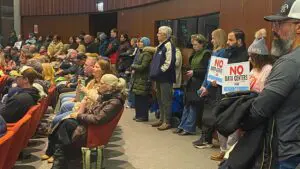
Public weighs in during lengthy hearing
Mirroring public comment at Planning and Zoning Commission meetings this past fall, the council at its Jan. 20 meeting received a range of comments about the data center proposal from more than 40 speakers. Health risks, and adverse property value impacts have been among the concerns shared throughout the debate.
“Diesel exhaust is a known carcinogen; that is not debatable,” Sujay Shah, a resident and oncologist, said. “Risk increases when diesel exhaust comes from stationary, concentrated sources — exactly what is proposed here. This is not the same as diesel exhaust from an Amazon truck or fast-moving traffic on a highway half a mile away. That is why, historically, heavy industry is separated and placed away from residential neighborhoods.”
The council at its most recent meeting also heard from a number of tradespeople who were supportive of the project proposal.
“This is not just another construction project; it’s an opportunity to bring jobs, investment, and new opportunities to Naperville,” said Anthony Giunti, a Naperville resident and international representative of the International Brotherhood of Electrical Workers’ 6th District. “During construction, local contractors, union trades, and suppliers will see millions of dollars at work. This is money that will be spent directly in our local economy.”
If you have a story idea, we want to hear from you!